Keeping Jersey Buff Turkeys on a Heritage Turkey Farm
The Jersey Buff is a Wonderful Turkey Breed

Reading Time: 5 minutes
By Christina Allen Keeping Jersey Buff Turkeys on a Heritage Turkey Farm- Of the few people keeping flocks of heritage turkeys, most seem to either just buy a few poults to raise for harvesting in the fall or are larger scale breeders. There is scant information on breeding and keeping turkeys on a homestead or small heritage turkey farm.
I am working to keep critically endangered Jersey Buff turkeys and keep a small naturally breeding flock. At first I modeled their facilities similarly to my day-ranging heritage farm for chickens. But after reading Temple Grandin’s book Understanding Animal Behavior, I closely watched them and started to change their housing and rearing areas to suit their likes and dislikes. It is quite obvious. If you build it right, they will take to it enthusiastically. Many people say turkeys are stupid. But it’s clear to me that we are the dull-witted ones who haven’t spent much time on a heritage turkey farm. We try to make animals conform to our ways instead of seeing what they are trying to “tell” us. Turkeys have quite an extensive vocabulary. Each sound means different things. But they can’t speak words, so it’s our duty to observe them and see what they want and provide it. In turn, I get sociable happy birds that are great moms and with high survivability of them and their offspring. But I’m not following the conventional agribusiness model. I’m approaching it more artistically, naturally, and environmentally.
Turkey Behavior

Buffs are curious birds, and they need regular stimulation (toys) to keep them actively engaged. They’re quite sociable and definitely benefit from early handling. Buffs are easy to herd, which makes tucking them in for the night pretty easy. I use a simple bamboo pole, held horizontally, to gently move the flock from place to place. When possible, herd them through openings that funnel them into smaller spaces to catch and handle them. Work with them at their speed and try not to rush them.
Toms are inclined to fight when they mature, so you’ll need to be selective with your breeding birds to take the edge off their aggression. The hens are quite sociable and gentle for visitors, especially since we hand-raise them. When we have visitors to the farm, our birds like to be petted and touched. They are a great hit.
Feeding Jersey Buff Turkeys
Heritage turkeys love to range and we’ve let them loose in our orchard where they eat bugs and fertilize our trees. They also have a “sweet beak” and love gobbling up fallen fruit as well as the long grasses at the base of the trees. Integrating the turkeys into our farm has always helped our organic fruit production.
Turkeys require less protein than chickens do. If they have access to a pasture diet, you’ll save a lot of money on feed.
Housing on Our Heritage Turkey Farm
We use electric netting around the orchard when they are day-ranging. This doesn’t keep them from flying out if they are chasing away a hawk, but they’ll walk around the fence perimeter until we let them back in. The toms usually stay with their flock. If you have repeat escapees, you can clip one wing. We just have to remember to redo the clip when the feathers have grown back.
They don’t mind snow, sleet, or rain. But in hard-driving rain or snow, they will need a place to shelter. And they also like to get out of strong winds.
We’ve noticed that when they all roost, the process goes much more smoothly if all the roosting bars are at the same level to eliminate jocking for hierarchy. Round roosting bars (or tree limbs) are also more comfortable for them to grip than square or rectangular ones.
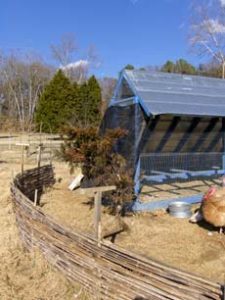
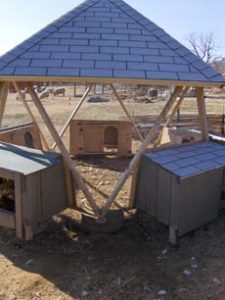
Some of the facilities I have made for our turkeys include a “hobbit house dust bath,” “the Blue Roost,” the “Pentagon Nursery,” a 6″ PVC pipe feeder with a covered top (for keeping mice out at night), and a bamboo woven wattle wind barrier fence. I’ve also made bentwood trellises for daytime perching and recycled a large rabbit cage for a temporary holding house for up to six birds.

Nesting Practices
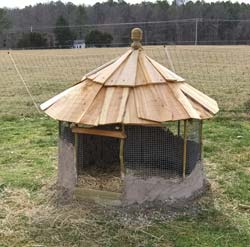
Like quail and pheasant, turkeys are ground nesting birds and prefer deep grasses (cut or fresh) and the more constant temperature of the insulated dirt. Hens need some privacy, but also want to be able to see out enough for protection. If you are making nesting boxes, create hen-sized openings to the toms won’t disturb the hens or eggs. Sliding doors let you adjust the opening as needed.
If your birds start laying really early in the spring when it’s still cold, consider eating those eggs rather than letting them hatch. The hens will keep laying, and may hatch-out two times per season.
Parenting
Heritage turkeys are generally good parents. Two hens will sometimes share a nest and parent all the newly hatched poults. Most toms will protect the poults on the nests and keep them warm, but some aren’t as friendly. You’ll have to learn your tom’s instincts.

The first three weeks of a poult’s life are the most difficult due to temperature and disease vulnerability. After the three-week mark, their survivability jumps markedly. They can be prone to leg injuries, most of which can be corrected if caught immediately. They respond well to splints and gentle physical therapy.
While parents will teach then how to eat and drink, you can help the process by putting marble or other shiny things (large enough not to be swallowed) in their food and water to attract their attention.
They are a bit of work on our heritage turkey farm , but I enjoy them more than I ever possibly could have imagined. One needs a sense of humor with turkeys. Jersey buff turkeys are an elegant bird, well worth saving from extinction.
Christina Allen has been a professional artist for nearly 30 years. She lives in Southern Maryland, homesteading, with her husband, her flock of rare Jersey Buff turkeys, heritage chickens, and sheep. They enjoy sustainable gardening by raising most of their own food. Christina finds much inspiration for her artwork in this way of life and with the beautiful Chesapeake Bay around the area. She is also an avid handweaver, spinner and knitter.
Originally published in Backyard Poultry June / July 2009 and regularly vetted for accuracy.