


Incubating Duck Eggs with Chicken Eggs
Calculating Duck Egg Incubation Time for a Successful Hatch with Baby Chicks

If you have already tried incubating chicken eggs, you know how addicting it can be. Have you tried incubating duck eggs? And can you incubate duck eggs with chicken eggs, conserving space while only focusing on one hatch time?
In all the literature I have studied regarding how to hatch chicken eggs vs. duck eggs, I have never read anything that advised NOT doing it. The same procedures used for incubating chicken eggs can also be used for incubating duck eggs … with a few adjustments.

There is an audio version of this article for your listening pleasure. Scroll down a little bit and look for the “Audio Article” link.
Size
Incubators are usually constructed specifically for hatching chicken eggs of a standard size, though pullet or Bantam eggs may need a smaller insert if you are using an automatic egg turner. If you only have the most basic of incubators, in which eggs are set on a wire screen and turned manually, this isn’t an issue. But if you are using a larger incubator with turners, you may need to purchase separate sizes for duck eggs vs. chicken eggs so the eggs do not jostle when moved. Too much jostling can create hairline fractures or cause abnormal development of chicks/ducks.

Time

How long does it take for chicken eggs to hatch? Twenty-one days, give or take a couple of days if temperatures are off. Incubating guinea eggs takes 28 days — the same amount of time it takes to incubate standard duck eggs — though some experienced guinea fowl owners say it takes 25-26 days with a well-calibrated incubator. Muscovy eggs take 35 days. Geese can take 28-35 days, depending on whether they are a lighter or a larger breed.
But chicken egg incubation time can coincide with the window for incubating duck eggs if you do a little math.
Temperature and Humidity
The California Poultry Workgroup and the University of California’s Cooperative Extension recommends the following:
Still-Air Incubators
Maintain the temperature within the incubator at approximately 102 degrees Fahrenheit, with 60% to 65% relative humidity. Place the thermometer at average egg height. Fill water pans just prior to use, and replace water every 3 to 4 days throughout the incubation period. Place the eggs horizontally and turn them 180 degrees on the long axis, three or more times per day (an odd number).
Forced-Air Incubators
Maintain a dry bulb temperature of 99.5 degrees and a wet bulb temperature of 88 degrees, with 65% relative humidity.
In general, temperature and humidity needs are so similar for incubating duck eggs and chicken eggs that it’s not a concern. The Texas A&M AgriLife Extension Service lists the incubation temperature for duck, chicken, goose, and guinea fowl eggs as 99.5 degrees and the hatching temperature as 98.5 degrees for duck, chicken, and goose eggs, with 99 degrees listed for guinea fowl eggs. Muscovy duck eggs require the same temperature as eggs from standard domestic ducks descended from Mallards.
Humidity can vary. The Texas A&M AgriLife Extension Service recommends the following incubation humidity levels for various eggs:
- Chicken: 58%
- Duck (including Muscovy): 58% to 62%
- Goose: 62%
- Guinea fowl: 54% to 58%
And for hatching, it recommends:
- Chicken: 66 to 75%
- Duck (including Muscovy): 66% to 75%
- Goose: 66% to 75%
- Guinea fowl: 66% to 75%
Audio Article
Download this audio article or follow Mother Earth News and Friends on Spotify or iTunes for more!
Egg-Hatching Basics
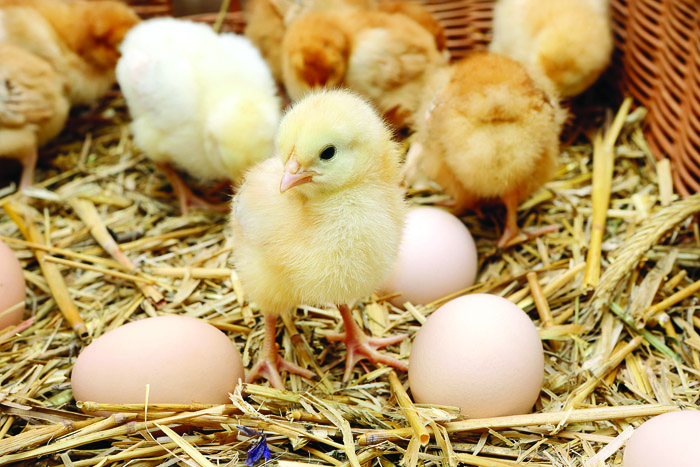
Whether you’re incubating duck eggs or hatching chicken eggs, these same guidelines apply:
- Store fertile eggs at 55-65°F, pointed side down.
- Set eggs within seven days of lay, if possible, and no more than 10 days after lay.
- Select clean eggs. Do not wash or wipe eggs, as this can remove the bloom that defends against bacteria.
- Select “normal” eggs, not double-yolkers, odd shapes, or eggs that appear too large or too small. Often these will hatch but the chick/duckling may be weak or improperly developed. Discard cracked eggs.
- Sanitize the incubator before starting, since 99°F is an optimal temperature for any existing bacteria to grow.
- Set the incubator in a safe area away from kids and pets, direct sunlight, and drafts.
- Start the incubator two days before you intend to set the eggs, to ensure it holds the correct temperature and humidity.
- Warm eggs at room temperature before setting in the incubator so condensation does not develop.
- Be sure to turn eggs three times a day until lockdown, whether they are duck, chicken, goose, or guinea fowl.

Don’t start a fire or overheat your chicks.
Get a brooder that is SAFE!
Highly efficient low cost brooders ideal for keeping newly hatched chicken, game and waterfowl warm. They are available in 2 sizes: the EcoGlow 20 suitable for up to 15 chicks and the EcoGlow 50 for up to 40 chicks.
Lockdown!
The most important time window, when incubating duck eggs or chicken eggs, is the lockdown phase. Often, a separate “hatcher” is used for this lockdown period, which doesn’t turn the eggs but maintains a higher level of humidity.
“Lockdown” is when opening the incubator can result in a humidity drop, which can dry membranes as chicks or ducks try to escape. Eggs do not need to be turned during the final two to three days before hatch; they just need to be monitored for temperature and humidity. Schedule your incubation times so lockdown coincides, allowing three days in which ducklings and chicks can hatch undisturbed.

When incubating duck eggs with chicken, goose guinea fowl, etc., get out your calendar. Mark your planned incubation dates based on the species which takes longest (such as Muscovy). Then count backward from hatch date, 21-28 days depending on species, and set your other eggs on that date.
If I was going to hatch Muscovy, Welsh Harlequin duck (or any other breed descended from Mallards), and chicken eggs together, starting March 1st, I would:
- Sanitize my incubator then start it on February 26th to be sure it works right.
- Set the Muscovy eggs on March 1st.
- Mark “lockdown” on my calendar as April 2nd.
- Mark “hatch” as April 4th-6th
- Set the other duck eggs on March 8th, candling the Muscovy eggs at the same time and discarding any that have not developed veins.
- Set the chicken eggs on March 15th, candling the duck eggs at the same time and discarding any that have not developed correctly.
- Turn all eggs three times per day, ensuring that the small ends point downward.
- Candle eggs weekly, discarding any that have not developed correctly.
- Observe hatch, ensuring that the incubator is not disturbed, and removing all chicks/ducklings within 24 hours after they have dried.

Incubating Duck Eggs Under a Broody Chicken
This is probably the easiest method of incubating duck eggs, since you don’t have to worry about time or humidity. I have hatched duck eggs under a Silkie hen, a standard-sized hen, and even under my heritage turkey. The ducklings hatched and thrived under the care of their foster mothers. If you have fertile duck eggs and an available broody, give it a go! Your hen won’t mind the extra seven days of incubation and will almost always be great mothers … up to the point where they panic when their web-footed babies jump into the water. However, if you are intent on incubating duck eggs with chicken eggs under your broody, slide the chicken eggs under your hen seven days after setting the duck eggs, so your broody doesn’t jump off the next to care for chicks before the ducklings can emerge.
Have you incubated duck eggs with chicken eggs? Tell us your experiences!
How to Effectively Delay Incubation
Chicken eggs should lose between 10% to 12% of their moisture content between setting and hatching; waterfowl eggs should lose around 14%. (Add another 0.5% if they’ve been stored more than seven days.) If much more or less is lost, the hatch rate can be negatively affected. Weighing eggs every two or three days during incubation can let you know if things are going well in the process and allow you to make adjustments if necessary. Once the eggs are close to hatching and enter the “lockdown” phase, it’ll be too late to make adjustments that will have any effect.
Resources:
“Hatching Duck Eggs” by William F. Dean, Ph.D., and Tirath S. Sandhu, DVM, Ph.D. Cornell University College of Veterinary Medicine: https://ahdc.vet.cornell.edu/sects/duck/hatching.cfm
“Muscovy Duck Care Practices” by California Poultry Workgroup and University of California — Cooperative Extension http://animalsciencey.ucdavis.edu/avian/muscovy1001.htm
“Incubating and Hatching Eggs” by Gregory S. Archer and A. Lee Cartwright, Texas A&M Agrilife Extension https://aglifesciences.tamu.edu/posc/wp-content/uploads/sites/20/2012/08/EPS-001-Incubating-and-Hatching-Eggs1.pdf






Its a nice guide which I was looking for, sharing with friends too. Thanks.
How to manage if I have put both chicken and duck eggs in incubator on the same day????
You can move the chicken eggs to a different incubator on lockdown day and leave the duck eggs to finish cooking.
Love the photo of the Columbian Wyandotte? with the hatching eggs, I have a Columbian Wyandotte that hatched out a pair of khaki Campbell’s duck eggs. She was sitting on 5 eggs originally but the 3 chicken eggs didn’t make it and one duckling died that night after hatching, leaving one lonely baby. Fortunately my local TSC had some ducklings so I bought a couple of them. Turns out they were Runner’s, 1 female and 1 male and the khaki Campbell was a male. The hen readily accepted both duckling. She raised all 3 as if her own, staying with them until 3 months old. Then the trio slept near her roosting bar for another few months, until the adults accepted them. They’re turning 4 this July and the female still lays a few days a week.
I’ve been hatching duck and chicken eggs together using chickens, ducks and incubating. I’ve got 1 chicken and 1 duck egg in an incubator right now, my Mallard, Trixie laid it but papa could be a khaki Campbell, Runner or mix of both.