The White Stuff on Egg Yolks is the Chalazae
A Twisted Tale of Suspense
Reading Time: 4 minutes
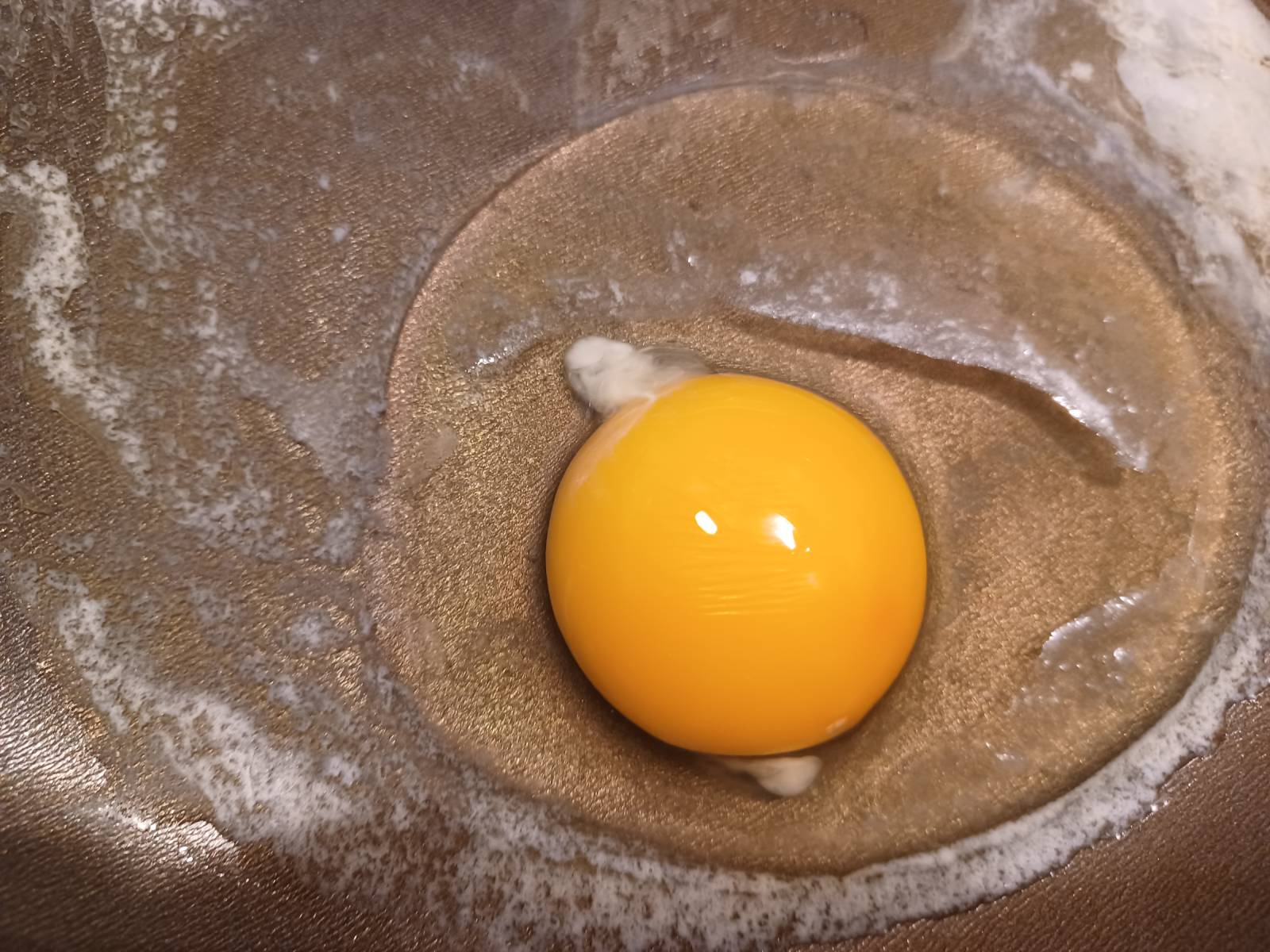
It’s early on a quiet Saturday morning, and you’re hungry for breakfast. Everyone in the house is still sleeping, so you sneak downstairs to the kitchen. You open the refrigerator door and pull out a carton of farm-fresh eggs. While a pad of butter melts in the skillet, you crack open an egg. Directing its contents onto the sizzling hot surface, you suddenly stop and stare at the raw egg intently. Strangely, peeking out from underneath the dark yellow yolk is something you’ve never noticed before. It’s small (just a few millimeters in length), white, and swirled.
“What’s the white stuff on egg yolks?” you wonder, making a face. Your stomach begins to turn as your imagination rapidly shifts into high gear. Like some people, you worry that perhaps the egg is fertile and that this twisted little thing is an embryo beginning to incubate. A gag reflex develops as your mind is carried away with common concerns expressed by other hungry egg-lovers observing this enigma for the first time. Maybe this odd little thing is some foreign material or even a wee bit of sperm from the rooster. Highly disturbed, you turn off the burner, dump the egg in the trash, and settle for toast instead.
Wondering What the White Stuff on Egg Yolks is?
Don’t let this sad ending come to your tasty breakfast when you experience such a close encounter someday, for this often-unnoticed spiral speck is an important part of every poultry egg. It’s a chalaza, one of two tiny rope-like structures found on either side of the yolk. Known together as chalazae, the pair tightly hold the lightweight fatty orb in the middle of the egg.
This unique function is critical for the viability of fertilized eggs, because it keeps the embryo, which is developing rapidly on the yolk’s surface, securely within the nutrient-rich egg white, or albumen. Here, the tiny new lifeform, also known as a blastoderm, is allowed constant contact with dozens of proteins that are essential for its growth. If not for the strong securing power of the chalazae, the yolk would float away and adhere to the shell. This would result in the death of the blastoderm due to contaminant exposure at the shell’s surface.
Although the two individual chalazae appear on opposite sides of the yolk, they do make contact with each other. At the egg’s center, both completely encase the yolk’s clear, protective tissue, called the vitelline membrane. From there, the two strands extend in different directions — always toward the ends of the egg.
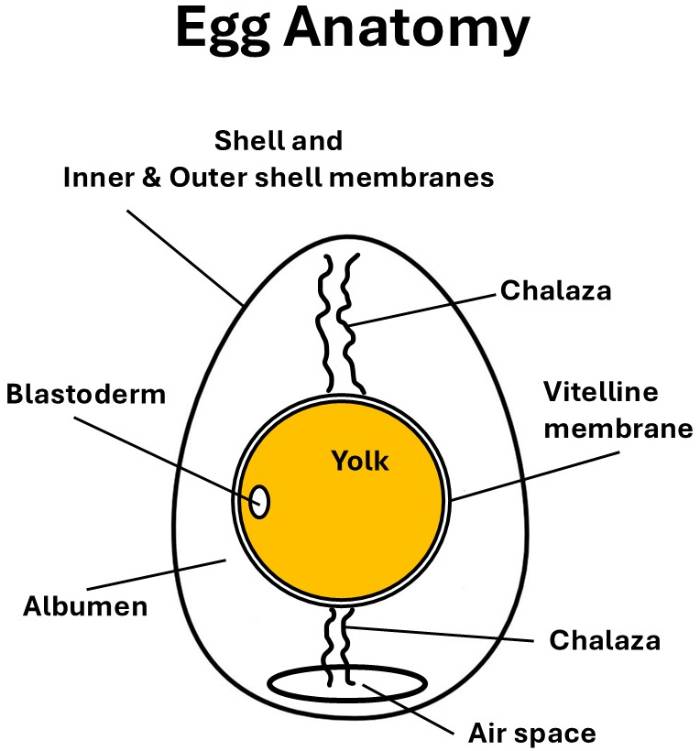
Made of thick, gelatinous fibers, one of them is firmly attached to the large end of the egg. Called the infundibular chalaza, this strand is twisted clockwise, as observed from the yolk, intricately woven together with similar fibers derived from the albumen. The other one, called the clocal chalaza, is fastened to the small end of the egg. It too is interwoven with fibers from the albumen, but the clocal chalaza is longer and bulkier than its counterpart.
Another difference between chalazae is the direction of their twist. When viewed from the yolk, the clocal has a counterclockwise orientation, opposite that of the infundibular. (Weird concept? Attach anything to two opposite sides of a ball and then spin the ball. Both objects will rotate in opposite directions when viewed from each side of the ball individually. One side will rotate in a clockwise direction, and the other side will do so in a counterclockwise direction.) So, in the same way, the opposite directions of twist by the chalazae allow the yolk to spin, stopping when its densest part is at the bottom.
It’s significant that the yolk can turn and reposition itself when moved. Consider the setting hen in her nest. Many times per day, she moves all her eggs around. As a result, the yolk spins inside each one, but the lightweight blastoderm always ends up on the top side, near the life-sustaining warmth of her body.
Truly, the chalazae have admirable abilities to nurture and protect the helpless little embryo. Understanding what the white stuff on egg yolks is now, you’re likely to see chalazae in a whole new way. It could be that the next time you crack open an egg and notice one of these whirled wonders hanging out with the yolk, you may find yourself becoming perfectly willing to eat it. It is, as I mentioned, made of nutritious protein fibers found in the albumen, after all. Of course, you may still be completely repulsed by it, and that’s okay. In any case, whether you nonchalantly whisk it in with the rest of the egg, or you carefully remove it with tweezers and throw it away, you’ll have newfound respect for the amazing chalazae, and that’s no twisted logic.
Mark M. Hall lives with his wife, their three daughters, and numerous pets on a four-acre slice of paradise in rural Ohio. Mark is a veteran small-scale chicken farmer and an avid observer of nature. As a freelance writer, he endeavors to share his life experiences in a manner that is both informative and entertaining. You can find him at ThePoultryChronicles.com.
Resources
Baker, R.C., and Stadelman, W.J. “Chicken Egg Chalazae-Strain and Individual Hen Variations and Their Relation to Internal Quality.” Poultry Science, May 1958, www.researchgate.net/publication/274659443_
Chicken_Egg_Chalazae-Strain_and_Individual_Hen_Variations_ and_Their_Relation_to_Internal_ Quality. Accessed 1 April 2025.
Originally published in the August/ September 2025 issue of Backyard Poultry and regularly vetted for accuracy.